
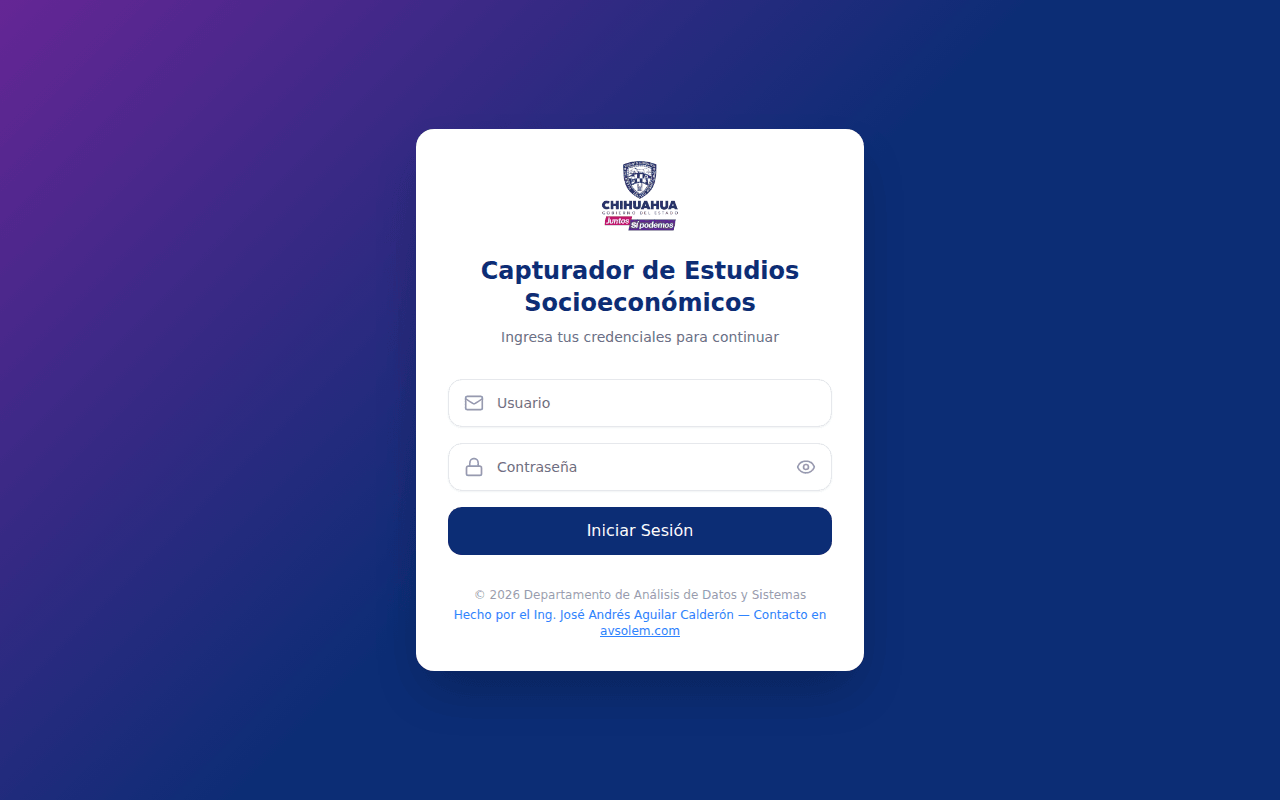
Overview
CES (Centro de Estudios Socioeconómicos) is the internal platform used by the Dirección de Grupos Vulnerables of the Government of the State of Chihuahua to run the Cuenta Conmigo social program end to end: from the first socioeconomic study of an applicant to the approval, delivery and receipt of each aid. It replaced paper forms with a single system shared by field staff, coordinators and administrators across the state's municipalities.
Access is restricted to government staff, so the public page is only the login screen.
Features
- 16-section socioeconomic study — applicant, guardian, household, health, social security, housing, basic services and signatures, with per-section validation and red/green completeness indicators
- Smart capture — age, sex and birth state derived from the CURP; CURP scanner support (camera QR and barcode gun); ZIP code autocomplete for municipality, locality and neighborhood
- Vulnerability index — a score computed from 30+ indicators of the study that classifies each household from economic solvency to extreme poverty
- Digital case file — ID, proof of address, disability credential and delivery receipts stored per beneficiary in Google Drive, with client-side image compression and thumbnails
- Beneficiary selection — approval by program and municipality with quotas per municipality, rejections with a reason and audited substitutions (one leaves, one enters)
- Home visits and delivery tracking — home visit forms, delivery dates captured from a calendar and a progress board
- Official printouts — study, acknowledgment of application, delivery receipts and passes that replicate the official letter-size formats
- Offline fillable PDF — a PDF version of the study that can be filled without internet and imported back into the system
- Reports and exports — statistics by office and municipality, CSV and configurable Excel lists per municipality and program
- Role-based access — administrator, supervisor, coordinator and capture roles, with coordinators limited to their assigned municipalities
Technical Details
- Frontend: Next.js 16 (App Router), React 19, TypeScript in strict mode, Tailwind CSS v4 and shadcn/ui
- Database: MongoDB with the native driver (no ORM), atomic updates and unique indexes to prevent duplicate folios under concurrent capture
- Auth: JWT in an httpOnly cookie with server-side role checks on every API route
- Documents: pdf-lib and pdfjs for printable and fillable PDFs, ExcelJS for spreadsheets, Google Drive API through a service account for the case files
- Compatibility: tuned for the older browsers found in government offices (webpack build and hex fallbacks for oklch colors)
- Deployment: self-hosted on a government VPS with Nginx, PM2 and MongoDB 8; a push to
maintriggers an automatic build and restart through a GitHub webhook